Which police scanner works in my area?
Type your ZIP code. We check the FCC licenses that police, fire and EMS hold in your county, then name the cheapest scanner that can hear that kind of radio.
Look up your county
The six answers, and the scanner for each
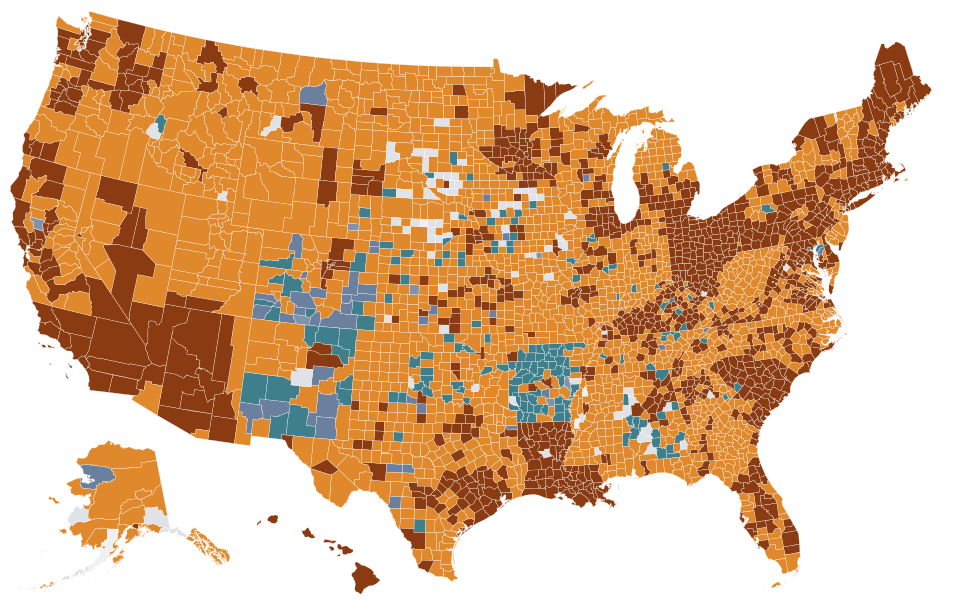
Every county gets one of six answers. Here is how many of the 3,138 counties in the 50 states and DC land in each, and the scanner we pick.
| What the licenses show | Counties | Our pick | Amazon |
|---|---|---|---|
| P25 digital, with simulcast | 1,019 | Uniden SDS200 | $749.99 |
| P25 digital | 1,828 | Uniden BCD325P2 | $399.00 |
| DMR or NXDN digital | 161 | Uniden BCD160DN | $244.17 |
| Digital, type unclear | 42 | Whistler TRX-1 | $599.99 |
| Analog, likely trunked | 9 | Uniden BCD325P2 | $399.00 |
| Analog | 79 | Uniden BC125AT | $137.65 |
Amazon prices as of October 14, 2026, 10:00 PM Pacific. Prices change; Amazon shows the current one.
Most of the country now needs a digital scanner
91% of US counties show P25 digital licenses for police, fire or EMS, and 97% show some kind of digital radio. A $150 analog scanner won't hear those agencies. Only 79 counties show analog radio alone. The most are in Iowa, South Dakota, Nebraska and Alabama.
What the FCC data can't tell you
- Encryption. Licenses don't say whether an agency scrambles its radio. We keep a dated list of agencies that encrypted, and the lookup warns you when your county is on it.
- Which system is the main one. A county can hold dozens of licenses. We show the agencies with the most frequencies, so you can see who runs what.
- Old licenses. An agency that moved to digital may still hold its old analog license. So "analog only" can be out of date. Digital signs are more reliable.
- Proof of Phase 2 or simulcast. We read these from the emission codes on each license. The codes come from radio maker literature, not FCC rules, so we call them signs.
Before you program a scanner, look up your county's systems on RadioReference. It is the hobby's own database and the best place to confirm what you'll hear.
Words you'll see
- P25
- The digital radio standard most US police and fire use. An analog scanner can't decode it.
- Phase 1 and Phase 2
- Two versions of P25. Phase 2 fits two calls on one channel. A Phase 1-only scanner misses Phase 2 calls.
- Simulcast
- One call sent from several towers at once. Many scanners garble it.
- Trunking
- A system where a computer hands out a few shared channels to many groups. You need a scanner that can follow it.
- DMR and NXDN
- Two other digital radio types, used by some smaller agencies and businesses. Most P25 scanners can't hear NXDN.
- Analog
- Plain, older FM radio. Any scanner hears it.
- Other digital
- A digital license whose code doesn't say which type it is.
- Channels and alpha tags
- A scanner's channels are memory slots for frequencies. Alpha tags are names you give them, like "Fire Dispatch."
- Bands (VHF, UHF, 700 and 800 MHz)
- The frequency ranges radios use. A scanner must cover your agencies' bands.
How the lookup works
We read the FCC's weekly license file, with 109,091 active public safety licenses. We place each license in its county by the address on file, or by its map point. Then we read the emission code on every frequency, which says how the signal is built. Analog FM, P25, DMR and NXDN each have their own codes. For the verdict we count every public safety licensee except schools, hospitals, utilities, transit, airports and jails. The answer names the agencies whose licenses set it. More on our method.